Why Korean Sunscreen Pills On Your Skin - and How to Stop It
Quick Answer: Pilling happens when a film-forming ingredient in one layer cannot bond with the layer underneath, so friction rolls both into visible flakes. The three most common causes are applying sunscreen before the previous layer has fully set, using too much product, and stacking silicone-based and water-based formulas in the wrong order. Wait 60 to 90 seconds between layers, use about a quarter teaspoon for the face, and press rather than rub.
If your routine has more than three steps and you leave the house in a hurry, the timing fix alone solves most of it.
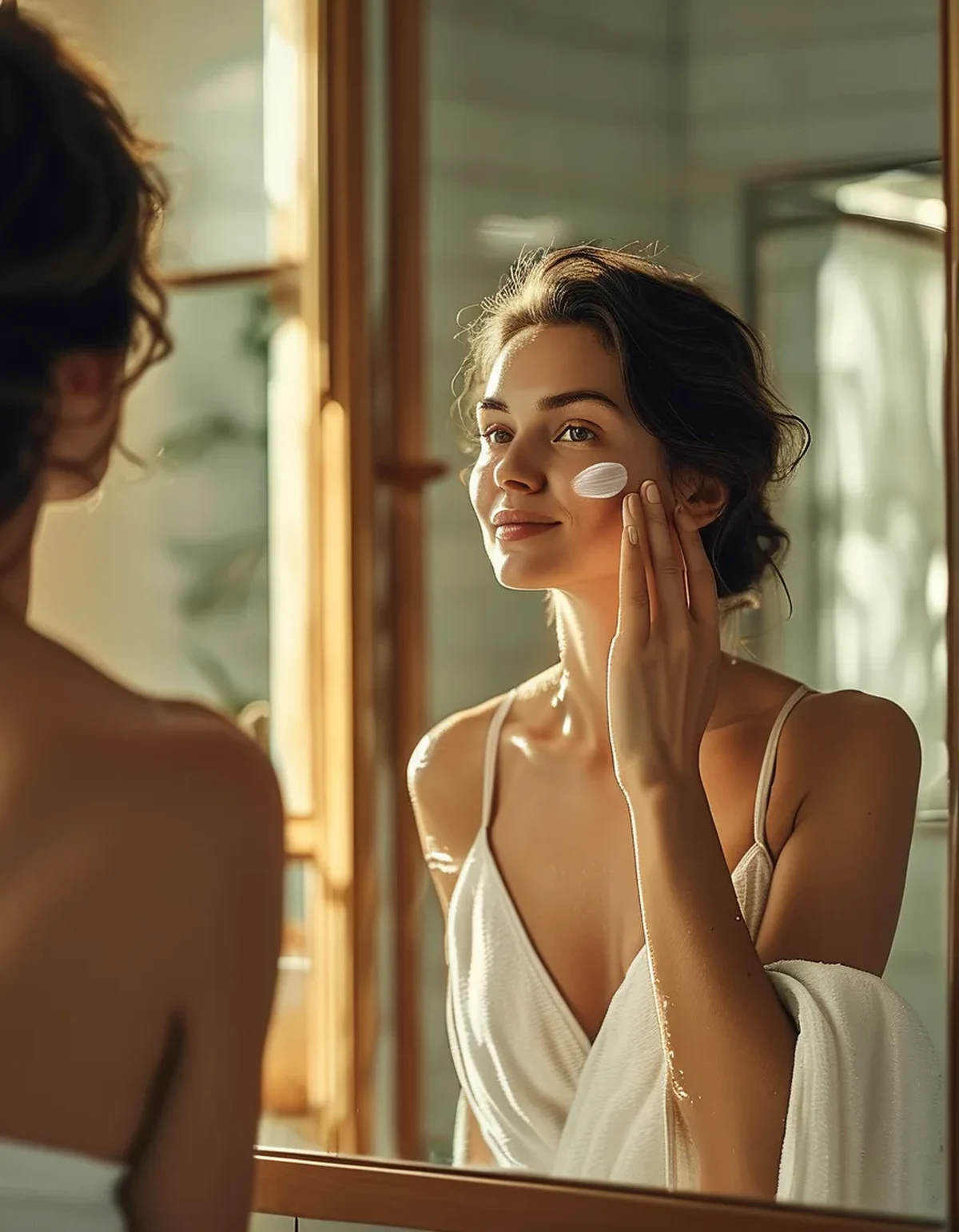
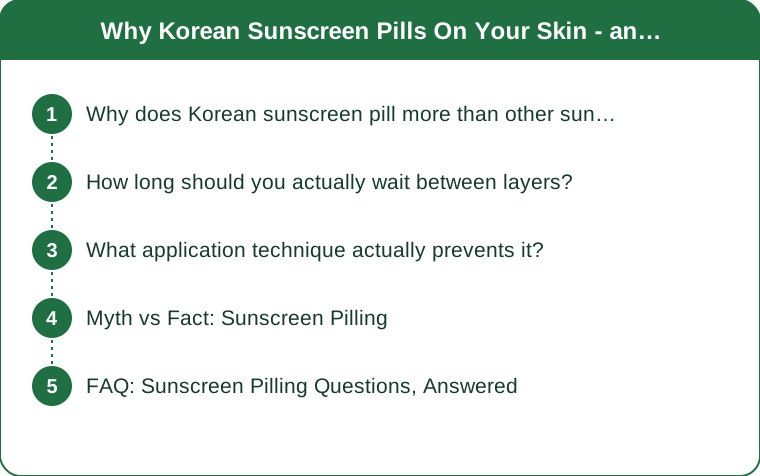
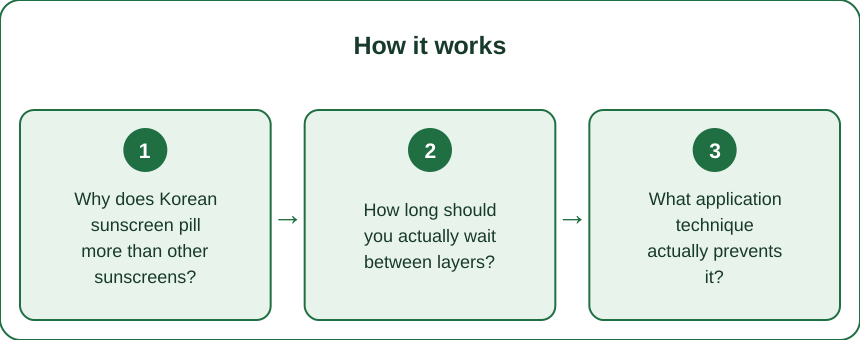
Why does Korean sunscreen pill more than other sunscreens?
It usually is not the sunscreen. It is what you put under it, and Korean routines put more under it than most.
Modern Korean sunscreens are built to feel light and finish invisible, which means they rely heavily on film formers - ingredients that dry down into a thin continuous layer. Acrylates copolymer, various silicones, and certain gums all do this. That film is exactly what makes the sunscreen sit beautifully under makeup and resist sweat. It is also what rolls up when it is disturbed before it has set.
The layers underneath matter just as much:
- Hyaluronic acid serums and essences leave behind a slightly tacky residue that never truly sets on some skin types
- Thick occlusive creams stay mobile on the surface for several minutes
- Silicone-heavy primers or moisturizers repel water-based sunscreen and refuse to blend
- Chemical exfoliant residue leaves loose dead skin that gives the pill something to gather around
Add the classic Korean layering habit - toner, essence, serum, moisturizer, then sunscreen - and you have four films competing for the same few microns of space. Any one of them not fully absorbed becomes the failure point.
There is also a plain physical cause that gets overlooked. Rubbing. Sunscreen needs a fairly generous amount to reach its labeled protection, and applying a generous amount with vigorous circular rubbing is the single most reliable way to produce pilling on any skin, in any country.
How long should you actually wait between layers?
Longer than feels reasonable, and less long than the internet suggests.
The widely repeated advice is to wait several minutes between every step. In practice, 60 to 90 seconds is enough for most layers, and the test is tactile rather than timed: touch the back of your finger to your cheek. If it feels cool, the water is still evaporating and the layer has not set. If it feels neutral and slightly tacky but nothing transfers, you are ready.
A workable morning sequence with realistic timing:
- Toner - 30 seconds, it absorbs quickly
- Essence or serum - 60 seconds
- Moisturizer - 90 seconds, and this is the one people rush
- Sunscreen - apply in sections, press in, then leave it alone for 2 minutes before makeup
That total is about five minutes of waiting, which is why the honest answer for busy mornings is to use fewer layers rather than to wait less. A hydrating toner and a moisturizing sunscreen is a complete morning routine for a lot of people, and it never pills.
Amount matters too. The dermatology guidance for adequate facial coverage is roughly a quarter teaspoon, or two finger-lengths of product. That is a lot more than most people use, and it is a lot more than most faces can hold without rolling if it goes on all at once. The solution is to divide it: half on the face in sections, wait 60 seconds, then the second half. Two thin passes give you the same protection with none of the pilling.
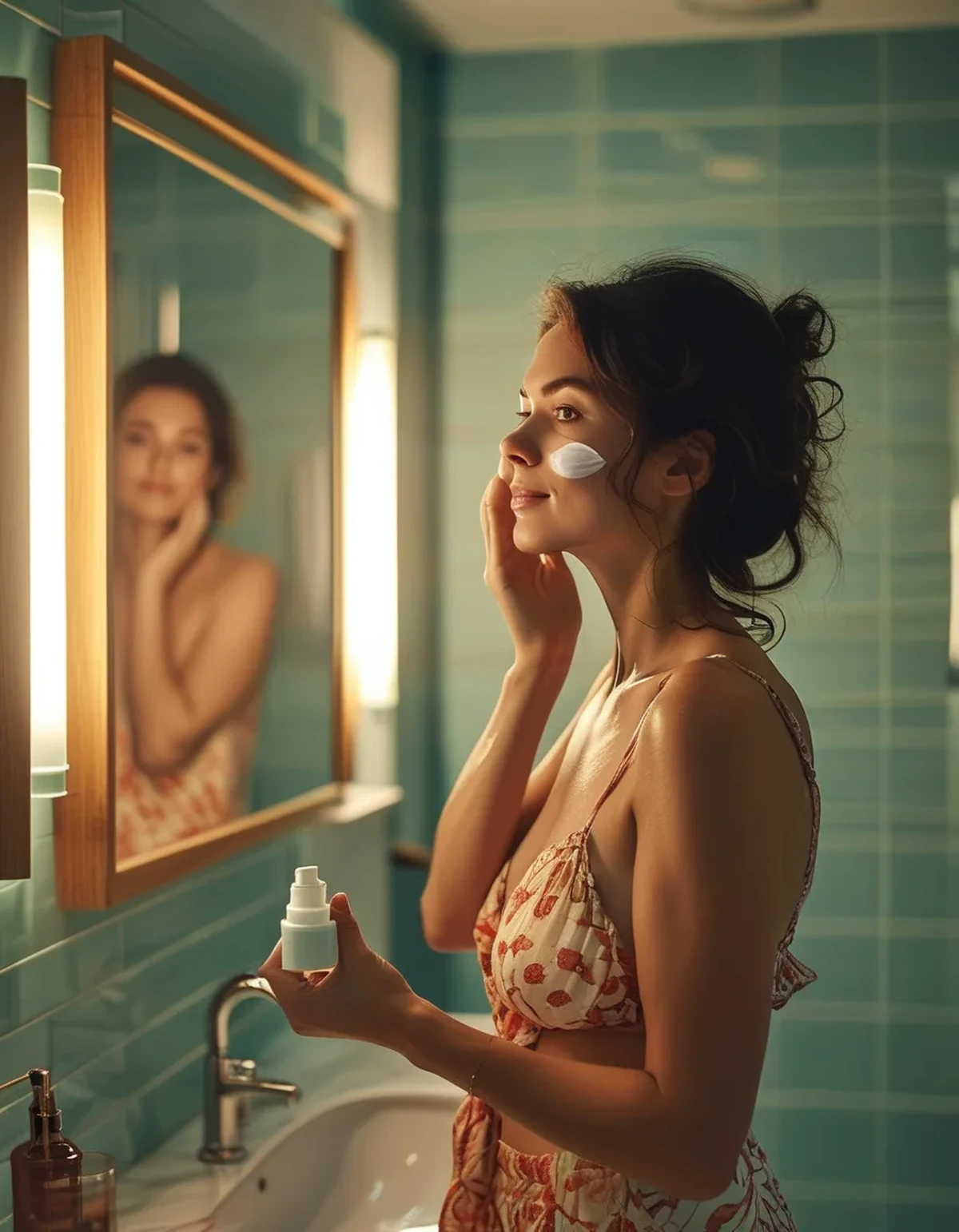
What application technique actually prevents it?
Press, do not rub. That single change fixes more pilling than any product swap.
Dot and press. Place five or six dots across the face, then use flat fingertips to press the product down and outward. No circles, no massaging. Circular rubbing generates the shear force that rolls films into pills; pressing does not.
Work in sections. Forehead, then each cheek, then nose and chin. Finishing one section before moving on means each area gets a brief undisturbed setting period.
Go in one direction. If you must sweep, sweep downward with the direction of facial hair. Back-and-forth motion disturbs the layer twice.
Skip the jade roller and gua sha in the morning. Both drag across every layer you just applied. Save them for evening routines with fewer film formers.
Let the sunscreen set before makeup. Two full minutes, and longer in humid weather. Applying foundation into a sunscreen that has not set is the most common pilling scenario of all, and it ruins both layers.
A useful diagnostic if you cannot identify the culprit: apply one layer at a time on consecutive days. Sunscreen alone on day one. Moisturizer then sunscreen on day two. Add the serum on day three. The day it pills is the day you found the incompatible layer, and it is usually not the one you expected.
Myth vs Fact: Sunscreen Pilling
Myth: Pilling means the sunscreen is bad quality. Fact: Pilling is a compatibility and technique issue, not a formulation defect. The same sunscreen that pills over one moisturizer will apply perfectly over another. Some of the most cosmetically elegant Korean sunscreens pill most easily precisely because their film formers are so effective.
Myth: If it pills, you are still protected. Fact: You are not, and this is the part that matters. Pilling physically removes sunscreen from the skin. The rolled flakes are product that is no longer providing coverage, and it comes off unevenly, leaving patchy protection. Pilling is a sun protection problem, not just a cosmetic one.
Myth: Waiting longer between every step always helps. Fact: Waiting helps until a layer is set, then stops helping. Waiting ten minutes after moisturizer does nothing that ninety seconds did not already do, and the extra time is why people abandon the routine.
Myth: You need to match all products from one brand. Fact: Brand matching helps only because it makes formulation styles consistent. What actually matters is the base - water-based under water-based, silicone-based under silicone-based. Mixing across brands within one base type is fine.
Myth: Sunscreen goes under moisturizer for better absorption. Fact: Sunscreen is always the last skincare step, because it needs to form a continuous film on the surface. Putting moisturizer over it disturbs the film and dilutes the protection.
Myth: Chemical exfoliants in the morning cause pilling. Fact: The exfoliant itself does not. Loose dead skin that has not been rinsed off does, which is an argument for using them at night and cleansing properly in the morning.
FAQ: Sunscreen Pilling Questions, Answered
Can I fix pilling without starting over?
Sometimes. If it is minor, press a damp fingertip over the pilled area to lift the flakes, then pat a small amount of sunscreen back over that spot. If more than a small patch has rolled, wash and restart - patchy sunscreen is worse than a two-minute delay.
Does mineral or chemical sunscreen pill more?
Mineral formulas pill more often, because zinc oxide and titanium dioxide need heavier film formers and thicker textures to stay suspended. If you have tried everything and still get pilling, switching to a lightweight chemical or hybrid Korean formula is a reasonable next step.
Why does it pill some days and not others?
Humidity and how fast you moved. On humid late-summer mornings, layers take noticeably longer to set, so the same routine that worked in dry weather now needs an extra 30 to 60 seconds per step. The seasonal shift catches people out every August and September.
Does pilling mean my skin is not absorbing anything?
No. Absorption happens at the ingredient level and continues regardless. Pilling is a surface film problem. Your serum did its job even if the layer above it rolled.
Should I just use fewer products?
Honestly, for most people, yes. Three morning steps that go on cleanly protect your skin better than six that pill. Save the layering for evening, when there is no sunscreen film to protect and no makeup going over it.
TL;DR:
- Pilling is a film-compatibility problem between layers, not a sign of bad sunscreen.
- Wait 60 to 90 seconds between layers and 2 minutes before makeup. The touch test beats the clock.
- Use about a quarter teaspoon for the face, applied in two thin passes rather than one thick one.
- Press and section, never rub in circles. That change alone solves most cases.
- Pilling removes protection, so it is a sun safety issue and worth fixing properly.
If your mornings are rushed, cut layers rather than cutting waiting time. A clean three-step routine outperforms a six-step one that rolls off by the time you reach the car.
Keep Reading
This article is for general informational and styling purposes only. Fit, sizing, and product availability may vary.