Why Korean Sunscreen Feels Different at the End of the Tube
Quick Answer: The sunscreen did not change formula, but the emulsion did drift. Lightweight Korean sunscreens are oil-in-water emulsions held together by surfactants, and every squeeze pushes air into the tube. Over three months that air oxidises the oil phase and slowly separates it, so the last quarter reads heavier, tackier and more prone to pilling. Heat accelerates it, which is why an August tube ages faster than a February one. It is still protective, but the texture you bought is mostly gone.
You bought the sunscreen because it disappeared into your skin. Now the same tube leaves a grey cast and balls up under your moisturiser.
Nothing was swapped. What you are feeling is an emulsion at the end of its life, and it is predictable enough to plan around.

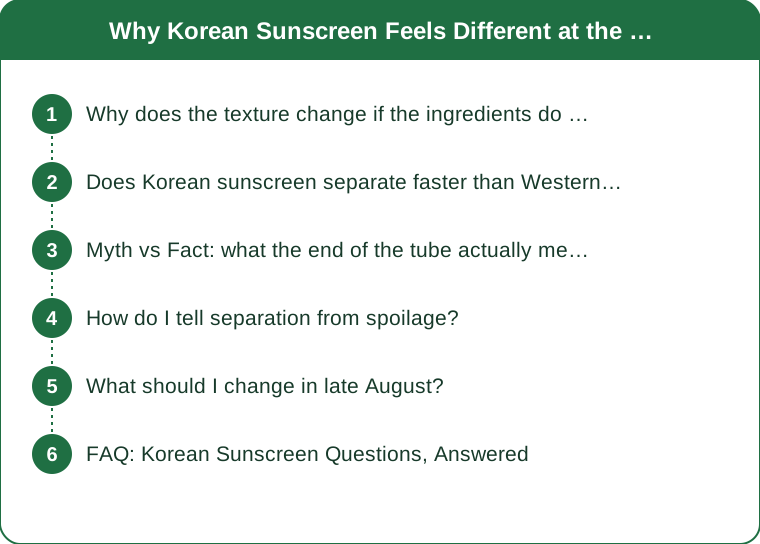
Why does the texture change if the ingredients do not?
An emulsion is a truce, not a solution. Oil and water do not want to be mixed, and surfactants hold them together in a suspension of droplets so fine that your skin reads them as one smooth fluid.
That truce degrades. Every squeeze pulls air into the tube, and air does two things: it oxidises the oil phase, and it gives the droplets room to find each other and merge. Larger droplets feel heavier. That is the entire mechanism.
By the time you are at the last 20 percent, you have typically opened the tube 150 to 200 times. The formula on the label is unchanged. The physical structure delivering it is not.
Does Korean sunscreen separate faster than Western sunscreen?
Often, yes, and it is a side effect of what people like about it. Korean sunscreens tend to run higher in water and lower in heavy occlusives, which is what produces that watery, no-cast finish.
A thinner emulsion has less structural buffer. Western sunscreens carrying more film formers and thicker esters hold their texture longer because the oil phase is already stiff. It is a trade: elegance now, or stability later.
Chemical UV filters used widely in Korean formulas are also more sensitive to heat exposure than zinc oxide is. Heat does not usually destroy protection outright in a sealed tube, but it does speed the drift you feel.
Myth vs Fact: what the end of the tube actually means
Myth: A separated sunscreen has stopped protecting you. Fact: Filters do not evaporate. A tube that looks slightly different but smells normal is almost always still delivering close to label protection, assuming it is inside its expiry.
Myth: The pilling is your moisturiser’s fault. Fact: Pilling is friction between two films that no longer bond. Late-tube sunscreen has a coarser droplet structure, so it rolls instead of spreading. Same moisturiser, different partner.
Myth: Storing it in the fridge fixes everything. Fact: Cold slows oxidation, but repeated cold-to-warm cycling can shock the emulsion and split it faster. Pick one temperature and stay there.
Myth: Shaking it re-mixes it. Fact: Shaking helps a formula that has only settled. It cannot rebuild droplets that have already merged.

How do I tell separation from spoilage?
Separation is cosmetic. Spoilage is not, and the signals are different.
Separation looks like: slightly thicker flow, a faint grey or white cast that did not used to be there, pilling under makeup, a thin clear film on the first squeeze of the day.
Spoilage looks like: a sour or crayon-like smell, a colour shift to yellow or beige, visible watery liquid that will not reincorporate, stinging on application.
The smell test is the reliable one. Rancid oils announce themselves. If the tube smells like it did in week one, you are dealing with texture, not safety.
Check the PAO symbol on the back too, the little open jar marked 12M or 6M. That clock started the day you opened it, not the day you bought it.
What should I change in late August?
Late summer is the worst month for a half-used tube because it has been through your car, your gym bag and a beach afternoon. A few practical fixes:
- Buy smaller tubes in summer. A 50ml you finish in eight weeks beats a 100ml you nurse for five months.
- Keep a dedicated bag tube and a home tube. The bag one takes the heat abuse and gets replaced faster.
- Squeeze less air back in. Press the tube, apply, then cap it without releasing your grip.
- Do not decant into a jar. Open jars oxidise several times faster and remove the one barrier the tube was giving you.
- Store upright, cap down, in a drawer rather than on a sunny counter. Every 10F of ambient heat roughly doubles the rate of chemical drift.
Here is the part that surprises people: the third fix, air management, usually buys you more good weeks than refrigeration does.
FAQ: Korean Sunscreen Questions, Answered
Should I throw out a sunscreen that pills?
Not if it smells normal and is in date. Move it to body use, where pilling under makeup is irrelevant, and start a fresh tube for your face. You get the full life out of the product without the daily annoyance.
Does re-application make late-tube sunscreen worse?
It can. The second layer has nothing smooth to bond to, so it rolls. Blot with a tissue first, or switch to a stick or cushion format for reapplication over makeup.
Is a watery Korean sunscreen a worse buy then?
No, it is a shorter-lived one. If you use sunscreen daily on face and neck you will finish a 50ml in about seven to nine weeks, which is well inside its stable window. The problem only appears for occasional users.
This is general information, not medical advice.
TL;DR:
- The formula does not change, the emulsion drifts as air oxidises and merges the oil droplets.
- Korean sunscreens separate sooner precisely because they are lighter and more water-heavy.
- Pilling and cast are cosmetic. Smell and colour shift are the real spoilage signals.
- Buy smaller tubes in summer, keep separate home and bag tubes, and stop letting air back in.
None of this means you chose badly. It means a lightweight emulsion is a perishable thing, and late August is when it perishes fastest. Treat your sunscreen like the fresh product it is and the last quarter of the tube will feel a lot more like the first.
Keep Reading
This article is for general informational and styling purposes only. Fit, sizing, and product availability may vary.