Why Your Korean Layering Behaves Differently in an Air-Conditioned Room
Quick Answer: Humectants like glycerin and hyaluronic acid pull moisture from whatever is available - the air, or your own deeper skin layers. In a humid room they draw from the air and your layering feels light and hydrating. In dry air-conditioned air they pull upward from your skin instead, which can leave it tighter than before. The fix is an occlusive step on top, not fewer layers.
Same products, same order, same amount, completely different result.
The variable you did not change is the one that matters: the humidity of the room you applied them in.

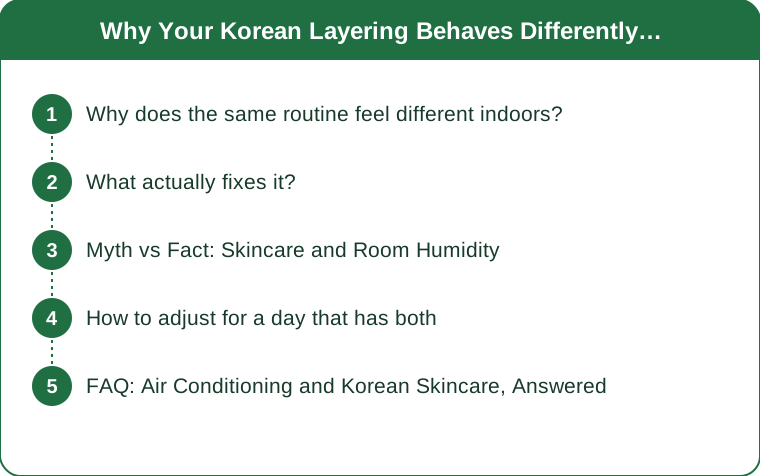
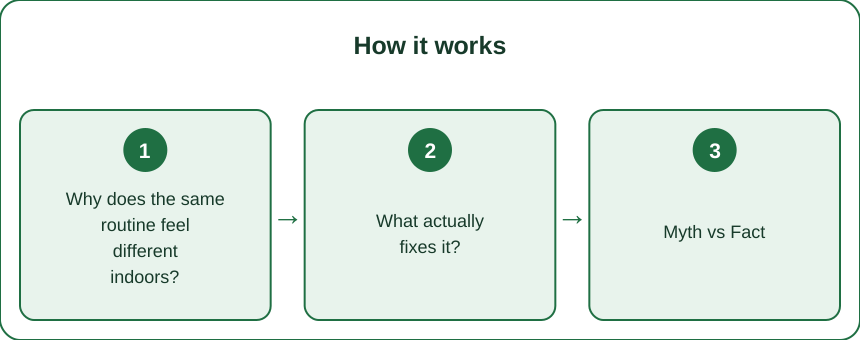
Why does the same routine feel different indoors?
Humectants are opportunists. Glycerin, hyaluronic acid, and the sugar alcohols in most Korean toners and essences bind water from the nearest available source, and they do not care whether that source is the air or you.
Above roughly 60 percent relative humidity, they pull from the air. That is the condition Korean layering was formulated around, and it is why the same routine feels effortless on a humid August morning outdoors.
Air conditioning routinely drops indoor humidity to 30 to 40 percent, and in that air the humectant draws from your deeper skin layers upward toward the surface, where it evaporates. The net result can be drier skin than if you had applied nothing.
This is the mechanism behind the classic complaint that hyaluronic acid makes some people’s skin worse. The ingredient is not failing - it is doing exactly what it does, in an environment that does not supply what it needs.
It also explains the sticky-then-tight sequence so many people report at work: sticky for twenty minutes while the humectant sits, then tight once the water it borrowed has gone.
The seasonal version of this is about to arrive. Indoor heating does the same thing air conditioning does, so a routine that struggles in a cold office in August will struggle in a heated flat in November.
What actually fixes it?
Seal the layers, do not remove them. An occlusive step on top - a cream, a balm, or a light facial oil - gives the humectant somewhere to hold the water instead of releasing it into dry air.
This is the single highest-impact change and it is why the same essence can feel entirely different depending only on what goes over it.
Apply to damp skin, not dry. Layering onto skin still slightly wet from cleansing gives the humectant water to bind immediately, which matters far more in dry air than in humid air.
Cut the number of humectant layers in dry rooms. Three watery layers in 35 percent humidity is more surface area for evaporation, not more hydration. Two layers plus a proper seal outperforms five layers on their own.
Move some hydration to the shower. Applying the first layer within sixty seconds of washing, while the bathroom is still humid, front-loads the routine into the most favourable conditions of your day.
Consider where you sit. Direct airflow from a vent dries the face measurably faster, and moving a desk by a metre has resolved more skincare complaints than most product swaps.
A small humidifier at the desk is the direct fix if it is available to you, and it does more for a dry-air skin problem than any additional product will.

Myth vs Fact: Skincare and Room Humidity
Myth: hyaluronic acid always hydrates. Fact: it moves water toward wherever it is applied. In dry air with no occlusive on top, some of that water comes from your own skin and then evaporates.
Myth: if your skin feels tight you need more layers. Fact: in dry air, more humectant layers without a seal frequently makes tightness worse. The missing step is occlusion, not volume.
Myth: oily skin does not need a cream in an air-conditioned office. Fact: oil production and water content are separate. Oily skin gets dehydrated in dry air too, and often responds by producing more oil.
Myth: the stickiness means it has not absorbed. Fact: stickiness usually means humectants sitting on the surface with nothing over them. Adding the seal resolves the stickiness rather than adding to it.
Myth: you should switch to a completely different routine indoors. Fact: the same products usually work with one added step and slightly less layering. Replacing everything is expensive and rarely necessary.
Myth: this only matters in winter. Fact: an air-conditioned office in August can be drier than an unheated room in November, which is why the problem shows up now.
How to adjust for a day that has both
Split the routine by where you will actually be. A morning routine for eight hours of air conditioning is a different problem from an evening routine at home with the windows open.
Morning, for a dry office: cleanse, one hydrating toner on damp skin, one essence or serum, then a proper moisturiser, then sunscreen. Four steps that end with a seal beats seven that end with a watery layer.
Evening, at home in humid late-summer air: you can layer more freely, and a lighter final step is often enough. This is the time to use the watery textures that struggle at your desk.
Carry one thing rather than a routine. A small balm for the areas that go tight first - usually cheeks and the sides of the nose - handles a mid-afternoon dip without disturbing makeup.
Mists are a mixed answer. A mist that is water alone can leave skin drier as it evaporates; one with humectants and a light emollient does not. Check the ingredients before assuming it helps.
Give any adjustment two weeks. Skin barrier changes take that long to show, and swapping routine every few days makes it impossible to know what worked.
As the season turns and heating replaces cooling, the same adjustment carries straight over - the mechanism is dry air, not the machine producing it.
FAQ: Air Conditioning and Korean Skincare, Answered
Why does my essence feel sticky at work but not at home?
In dry office air the humectants sit on the surface without binding much water, which reads as stickiness. Adding an occlusive step on top usually resolves it rather than making it worse.
Should I use fewer steps in an air-conditioned room?
Usually fewer watery layers and one more sealing layer. Two hydrating steps plus a proper moisturiser outperforms five hydrating steps with nothing over them.
Does hyaluronic acid really dry skin out?
It can, in low humidity with no occlusive on top, because it draws water from deeper skin toward the surface where it evaporates. Applied to damp skin and sealed, it does not.
Do I need a moisturiser if my skin is oily?
Yes, in dry air. Oil and water content are separate, and dehydrated oily skin often responds by producing more oil - which is why skipping moisturiser can make oiliness worse.
Are facial mists helpful at a desk?
Only if they contain humectants and some emollient. A pure water mist can leave skin drier once it evaporates.
Does a humidifier actually help my skin?
Yes, and it is the most direct fix available - it changes the condition causing the problem rather than compensating for it. Aim for somewhere around 40 to 50 percent relative humidity.
Will the same problem happen with indoor heating?
Yes, identically. Heating dries indoor air the same way cooling does, so the adjustment you make now carries into autumn unchanged.
TL;DR:
- Humectants pull water from the nearest source - the air in humid conditions, your own skin in dry ones.
- Air conditioning drops indoor humidity to 30 to 40 percent, which is well below what Korean layering assumes.
- Seal the layers with a cream, balm, or light oil rather than removing them.
- Apply to damp skin, use fewer watery layers indoors, and front-load hydration right after washing.
- Stickiness usually means humectants with nothing over them, not products that failed to absorb.
A desk humidifier fixes the cause rather than compensating for it. The same adjustment carries straight into heating season.
Keep Reading
This article is for general informational and styling purposes only. Fit, sizing, and product availability may vary.