Why Essence Absorbs Differently in Humid Versus Dry Air
Quick Answer: Essences rely on humectants like glycerin and hyaluronic acid, which pull water from whichever source has more of it. In humid air above about 60 percent relative humidity, they draw moisture from the air and feel like they absorb fast. In dry air, they pull from your deeper skin layers instead, which makes them sit tacky on the surface and can leave skin drier than before unless you seal them.
Your essence has not changed. Your air has.
That slightly sticky film that never quite sinks in, the pilling under sunscreen, the tight feeling two hours later — these all tend to arrive in the same two-week window every year, right as the humidity drops.
Here is the mechanism, and the three-second fix.
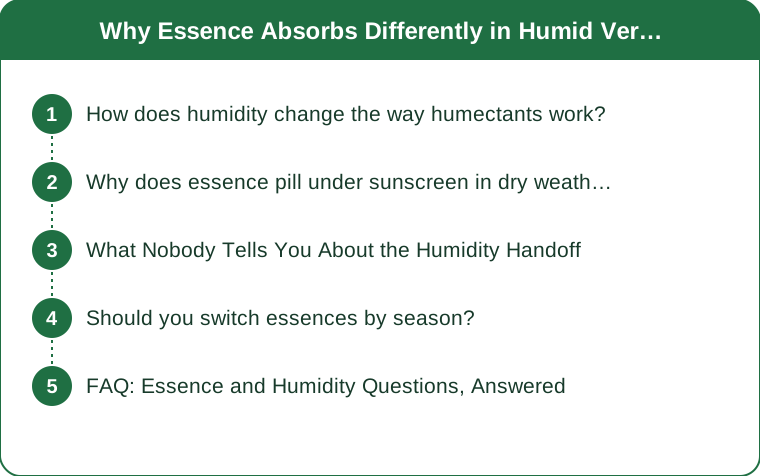
How does humidity change the way humectants work?
Humectants are moisture magnets with no loyalty. Glycerin, hyaluronic acid, butylene glycol, and panthenol all pull water toward themselves from whatever is nearest and wettest.
When ambient humidity is high — think 60 percent and up — the air is the wettest thing available. The humectant grabs atmospheric moisture and pulls it into your stratum corneum. Skin plumps, the product seems to disappear, and everything feels effortless.
When humidity drops below roughly 40 percent, the air has nothing to give. So the humectant reverses direction and pulls water from your own deeper skin layers up to the surface, where it evaporates. That is called transepidermal water loss, and a humectant applied without an occlusive on top can actively accelerate it.
This is why the exact same routine that gave you glass skin in August starts feeling like a dry, sticky mistake in October.
Why does essence pill under sunscreen in dry weather?
Pilling is a drying-rate problem. In humid air, layers stay slightly fluid longer and blend into each other. In dry air, the essence starts setting almost immediately, forming a partially dried film that rolls up the moment friction from the next product hits it.
Three things fix pilling almost every time:
- Wait 60 to 90 seconds between layers instead of 15
- Press, do not rub. Palms flat, three to five seconds per section
- Use less. Most people use two to three times more essence than the formula needs; the excess has nowhere to go but into a ball
If you are layering four products, cut it to two on dry days. Layer count is a humidity-dependent variable, not a fixed rule.
What Nobody Tells You About the Humidity Handoff
Nobody tells you that the fix is not a different essence — it is what goes on top of it.
A humectant with no seal above it is half a product. In humid weather the air completes the job. In dry weather you have to complete it yourself with an occlusive or emollient layer: a cream with squalane, shea, dimethicone, or petrolatum, applied while the essence is still slightly damp.
The order matters more than the products. Damp skin, humectant, then seal within about a minute. Sealing dry skin traps nothing.
Also worth knowing: indoor heating drops your bedroom humidity far below outdoor readings, often into the 20s. Your skin may be experiencing desert conditions for eight hours a night while the forecast says 55 percent. A cheap hygrometer costs about $12 and takes the guessing out of it entirely.
Should you switch essences by season?
Usually you do not need to. You need to change the ratio.
Late summer to early fall: keep the same essence, add a cream you skipped in July. Reduce to two layers total. Watch for the first tacky day — that is your signal, not the calendar.
Deep winter: consider an essence with a higher emollient content, or simply apply the same one over damp skin straight out of the shower and seal immediately.
Back to humid months: drop the heavy cream first, keep the essence. Most people over-correct and abandon hydration entirely in summer, then wonder why they get dehydrated-oily skin.
The essence is rarely the problem. The unsealed humectant is.
FAQ: Essence and Humidity Questions, Answered
Is hyaluronic acid bad in dry climates?
Not bad, just incomplete. It needs an occlusive on top and damp skin underneath. Applied to dry skin in dry air with nothing over it, it can leave you drier than doing nothing.
How long should I wait between essence and moisturizer?
Roughly 60 seconds in dry air, or until the tackiness fades but the skin is not fully dry. Do not wait for it to feel completely absorbed — you want to seal while there is still moisture to trap.
Does a humidifier actually help my skincare work better?
Yes, meaningfully. Bringing a bedroom from 25 percent to 45 percent relative humidity changes which direction your humectants pull overnight. It is one of the few skincare upgrades that improves every product you already own.
TL;DR:
- Humectants pull water from the wettest available source — the air when humid, your skin when dry
- Below about 40 percent humidity, an unsealed essence can increase water loss
- Pilling is a drying-rate issue: use less, press instead of rub, wait 60 to 90 seconds
- The fix is an occlusive layer applied within a minute, not a new essence
Check the humidity in the room where you actually do your routine. If it reads under 40, your essence is not underperforming — it is just waiting for a lid.
Keep Reading
This article is for general informational and styling purposes only. Fit, sizing, and product availability may vary.