Why Your Actives and Your Korean Layering Routine Keep Fighting Each Other
Quick Answer: Korean layering is built around hydration delivered in thin, watery layers onto damp skin. Western actives - retinoids, high-strength vitamin C, exfoliating acids - are built around penetration into skin that is dry and at a specific pH. Put them in the same routine without thinking and each one sabotages the other: the damp skin that makes essence work also drives actives deeper than intended, and the acid that makes an exfoliant work strips the barrier your layering was building.
The fix is almost never buying different products. It is separating them by time.
Here is what is actually happening, and the three ways to run both without a stinging face.
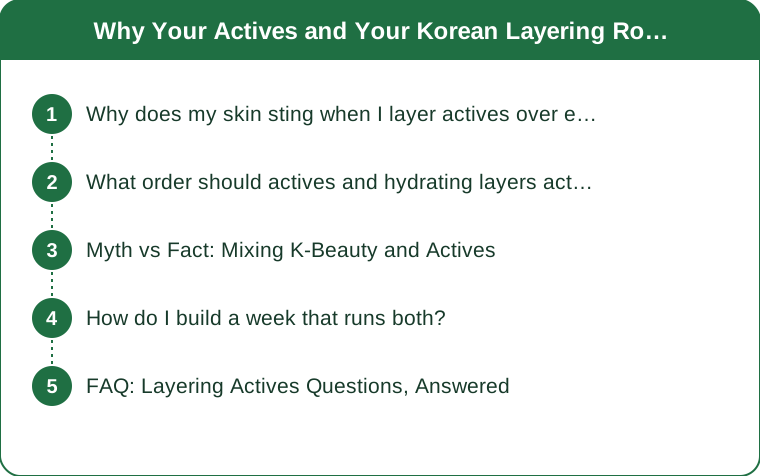
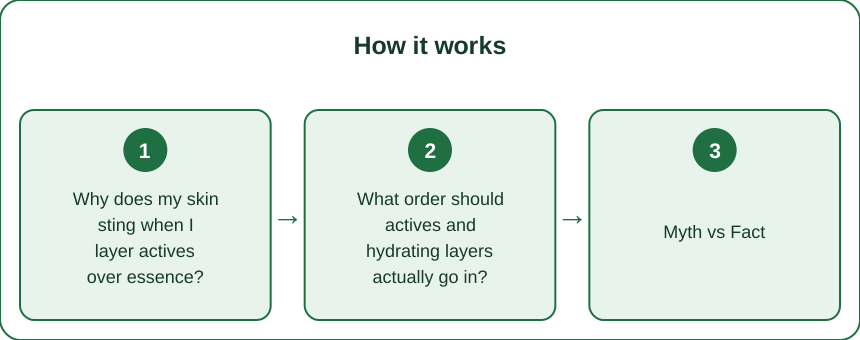
Why does my skin sting when I layer actives over essence?
Because damp skin is a different delivery system than dry skin, and the instructions on your active assume dry.
Water is a penetration enhancer. This is the whole mechanism behind Korean layering - applying onto skin that is still slightly damp measurably increases how much of a water-soluble ingredient gets in. That is wonderful for humectants like glycerin and hyaluronic acid, which you want sitting in the upper layers holding water.
It is much less wonderful for a retinoid or a 10 percent acid. The dose you tolerated on dry skin is not the dose you get on damp skin. The product has not changed strength; your skin has changed permeability, and the sting is the honest report of that.
Then there is pH. Exfoliating acids work in a narrow acidic window, roughly pH 3 to 4. A hydrating toner or essence sits closer to pH 5 to 6, which is where healthy skin likes to be. Layer one over the other immediately and you get a compromise pH where the acid works less well than the label promises and the skin still gets the irritation.
And the layers themselves matter. Seven thin layers of essence is not a neutral base - it is a hydrated, slightly swollen stratum corneum, which behaves differently than the skin the active was tested on.
None of this means the two approaches are incompatible. It means they need to be scheduled rather than stacked.
What order should actives and hydrating layers actually go in?
The general principle - thinnest to thickest - is a decent default and a poor rule once actives are involved. Order by function, not by texture.
The order that works for most people:
- Cleanse, then wait. Not 30 seconds - give it a full 10 to 15 minutes if you are using a retinoid or a strong acid. This is the single highest-value change in this entire article, and it costs nothing. Dry skin means predictable absorption
- Active first, onto genuinely dry skin. Pea-sized amount for the whole face if it is a retinoid. It goes early because it needs contact with skin, not with three layers of humectant
- Wait again, five to ten minutes
- Then the hydrating layers. Toner, essence, serum - this is where the Korean part of the routine happens, and it is now doing its actual job, which is buffering and rebuilding after the active
- Seal. Moisturiser, then an occlusive if your skin is dry or the weather has turned
The buffering variation, if you are sensitive: reverse the first two steps. Apply moisturiser, wait, then the retinoid on top. You get less penetration and less irritation, which is exactly the trade you want while building tolerance. Dermatologists have recommended this for years and it works.
What not to do: apply a strong acid and a retinoid in the same session, or layer a low-pH vitamin C directly under a niacinamide-heavy essence and expect both to behave. Give each one its own evening.
Myth vs Fact: Mixing K-Beauty and Actives
Myth: Korean routines do not use actives. Fact: They very much do - Korean formulations lean toward lower concentrations delivered more frequently, with a heavy emphasis on barrier support alongside. The difference is philosophical, not chemical. It is gradual and cumulative rather than aggressive and corrective.
Myth: You have to wait 30 minutes between every layer. Fact: Between hydrating layers, no - the whole point is to apply while damp. Between an active and everything else, yes, waiting matters. The rule people repeat as universal was only ever meant for one step.
Myth: Niacinamide and vitamin C cancel each other out. Fact: This comes from research on raw ingredients under heat, not on modern formulations, and it has been fairly thoroughly walked back. Most people can use both. If you get flushing, that is worth respecting on its own terms - but it is not the chemistry the internet claims.
Myth: If it stings, it is working. Fact: Stinging is a barrier signal, not an efficacy signal. A well-tolerated retinoid delivers results without a burning face, and the fastest route to a stalled routine is pushing through irritation until the barrier gives up.
Myth: More layers means more hydration. Fact: Past three or four thin layers, you are mostly applying water that will evaporate and take some of your own with it unless you seal properly. The seal matters more than the layer count.
How do I build a week that runs both?
The most reliable structure is alternating nights, and it is far less complicated than it sounds.
A workable week:
- Monday, Thursday: retinoid night. Cleanse, wait 15 minutes, retinoid, wait 10, then two hydrating layers and a solid moisturiser. Nothing else
- Tuesday, Friday, Sunday: full layering night. Toner, essence, serum, moisturiser, sleeping mask if the air is dry. This is your recovery and rebuild schedule
- Wednesday: exfoliating acid, at a frequency your skin actually tolerates - once weekly is plenty for most people, and twice is the ceiling for nearly everyone
- Saturday: whatever your skin is asking for. Usually more hydration
- Every morning: gentle cleanse or water rinse, one hydrating layer, moisturiser, and sunscreen without exception - actives raise photosensitivity and skipping the sunscreen undoes the entire project
Signs your schedule is too aggressive: tightness after cleansing, stinging from products that never used to sting, unexpected flaking around the nose and mouth, or foundation suddenly clinging in patches. Any two of those means you take a full week of hydration only, no actives at all, before restarting at half the frequency.
Give it 12 weeks before judging. Retinoid results are measured in months and cell turnover cycles - roughly 28 days each, longer as you get older. Six weeks is when most people quit and it is also roughly when things start working.
If you have persistent redness, painful breakouts, or a reaction that does not settle within a few days of stopping, that is a dermatologist’s question rather than a routine-tweaking question. This is general information, not medical advice.
FAQ: Layering Actives Questions, Answered
Can I use my essence in the morning and my actives at night?
This is the simplest possible version of the split and it works well. Mornings become hydration plus sunscreen, evenings alternate between active nights and recovery nights. Most people who resolve this problem end up here.
Does the 10-minute wait actually make a difference?
It does, and it is the change people are most sceptical about and most surprised by. Damp skin can substantially increase absorption of a retinoid, which is the difference between a therapeutic dose and an irritating one. Brush your teeth in the gap.
What about snail mucin and centella - do they interfere with actives?
No, and they are actually good partners. Both sit firmly in the barrier-support category rather than the active category, which makes them useful on the nights after a retinoid rather than something to schedule around.
My routine worked all summer and stopped in autumn. Did I do something wrong?
Almost certainly not - the air changed. Lower humidity means the same hydrating layers evaporate faster and the same active irritates more. Add an occlusive step and drop your active frequency by one night for the season.
TL;DR:
- Damp skin boosts absorption, which is great for essence and risky for retinoids and acids
- Apply actives to genuinely dry skin, wait 10 to 15 minutes, then layer hydration on top
- Buffer with moisturiser first if you are sensitive - less penetration, far less irritation
- Alternate nights rather than stacking: active nights and recovery nights, acid once a week
- Stinging is a barrier warning, not proof of results, and sunscreen is non-negotiable
If your routine started stinging when you added one product, do not rebuild the whole thing. Move that product to dry skin, wait ten minutes, and see what the week does.
Keep Reading
This article is for general informational and styling purposes only. Fit, sizing, and product availability may vary.