Snail Mucin in Skincare: What It Actually Does and How to Use It Right
Quick Answer: Snail mucin (snail secretion filtrate) is valued in Korean skincare for its blend of glycoproteins, hyaluronic acid, and allantoin, which together support hydration, help the skin barrier recover, and can smooth texture over consistent use — it works best applied on slightly damp skin right after cleansing, before heavier creams, and is generally well tolerated even on sensitive or acne-prone skin.
The name puts a lot of people off before they even try it, which is a shame, because the actual ingredient profile has more in common with a hydrating serum than anything unusual.
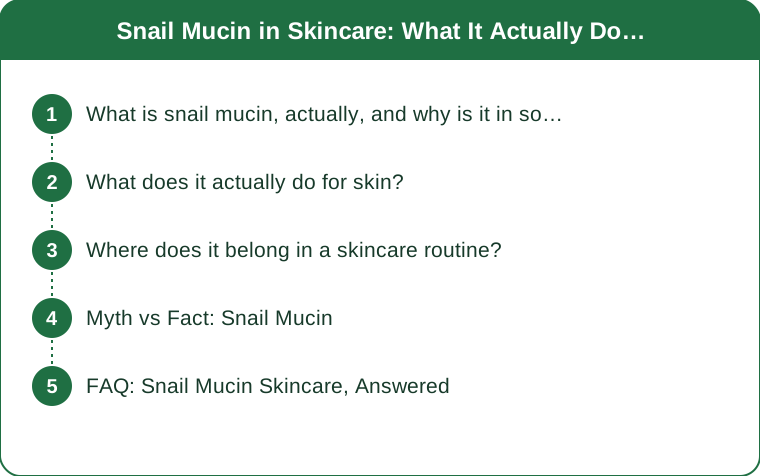
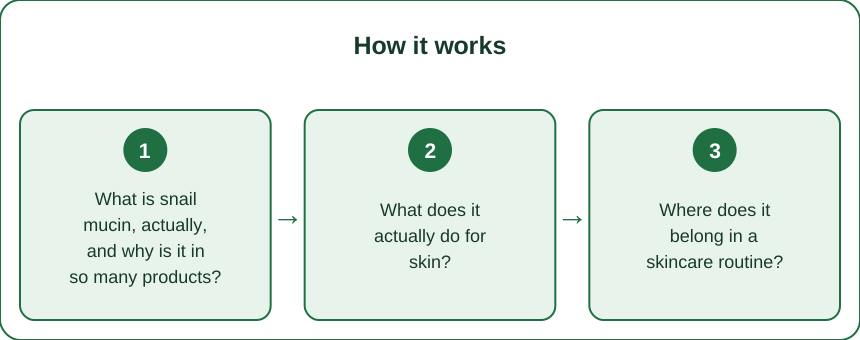
What is snail mucin, actually, and why is it in so many products?
Snail mucin is the secretion snails produce for their own skin repair and hydration, collected without harming the snails in reputable production methods, then filtered and processed into a cosmetic ingredient. It naturally contains glycoproteins, hyaluronic acid, glycolic acid, and allantoin — a combination that happens to overlap closely with what skincare formulators already reach for separately, which is part of why it became such a staple ingredient rather than a passing trend.
What does it actually do for skin?
The hyaluronic acid component draws in moisture, the allantoin supports barrier recovery and calms irritation, and the small amount of natural glycolic acid provides very mild exfoliation over time. Together, consistent use is associated with improved hydration, smoother texture, and in some cases a reduction in the appearance of fine lines and post-acne marks — though results build gradually over weeks, not overnight.

Where does it belong in a skincare routine?
Most snail mucin products are formulated as an essence or serum, meant to go on cleansed, slightly damp skin, after toner and before heavier moisturizers or oils. Applying it to slightly damp rather than fully dry skin helps it absorb more effectively, since the added surface moisture works with the hyaluronic acid component rather than against it.
Myth vs Fact: Snail Mucin
Myth: Snail mucin is too strange or gimmicky to actually work. Fact: Its core active components (hyaluronic acid, allantoin, glycoproteins) are well-established, functional skincare ingredients on their own — it’s an effective delivery format, not a novelty.
Myth: It’s only useful for dry skin. Fact: Its lightweight, non-comedogenic texture makes it generally well tolerated by oily and acne-prone skin too, since it hydrates without the heavier occlusive feel of some other moisturizing ingredients.
FAQ: Snail Mucin Skincare, Answered
Is snail mucin safe for sensitive or acne-prone skin?
Generally yes — it’s non-comedogenic and includes calming components like allantoin, though as with any new product, patch testing on a small area first is a reasonable precaution.
How long before results are noticeable?
Most users report visible hydration improvement within 1-2 weeks, with texture and tone improvements building more gradually over 4-8 weeks of consistent use.
Can snail mucin be layered with actives like retinol or vitamin C?
Yes, generally — its gentle, hydrating profile pairs well with most actives and can actually help offset dryness or irritation that stronger actives sometimes cause, though introducing new combinations one at a time is still the safer approach.
TL;DR:
- Snail mucin’s actual ingredient profile (hyaluronic acid, allantoin, glycoproteins) is functional, not gimmicky
- It supports hydration, barrier recovery, and mild texture improvement over consistent use
- Apply on slightly damp skin after cleansing and toner, before heavier moisturizer
- It’s generally well tolerated across skin types, including oily and acne-prone
The name is the strangest thing about it — the actual formula does exactly what a good hydrating essence is supposed to do.
Keep Reading
This article is for general informational and styling purposes only. Fit, sizing, and product availability may vary.