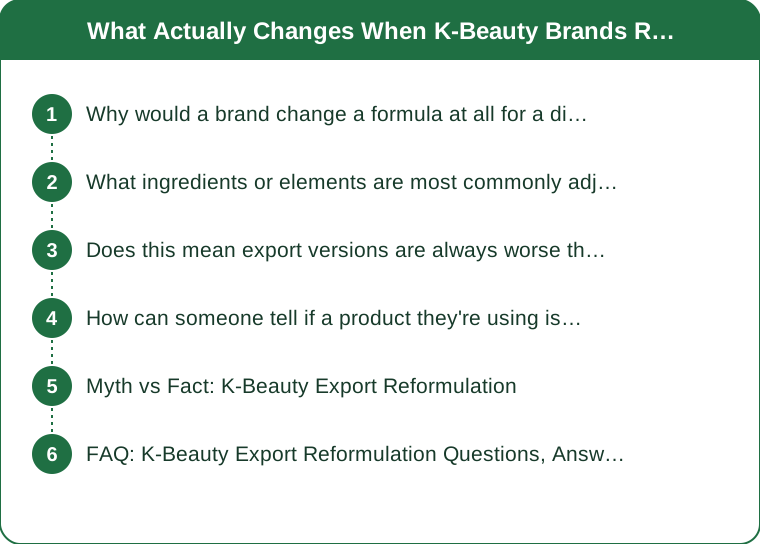
What Actually Changes When K-Beauty Brands Reformulate for Export Markets
Quick Answer: Export versions of K-beauty products sometimes adjust fragrance levels, certain active ingredient concentrations, or packaging claims to meet the destination market’s specific cosmetic regulations — the core formula philosophy usually stays similar, but it’s not always a truly identical product to the domestic Korean version.
A product with the same name and packaging design can still be a meaningfully different formula depending on which country’s shelf it’s sold on, and that’s often by regulatory necessity, not a downgrade.
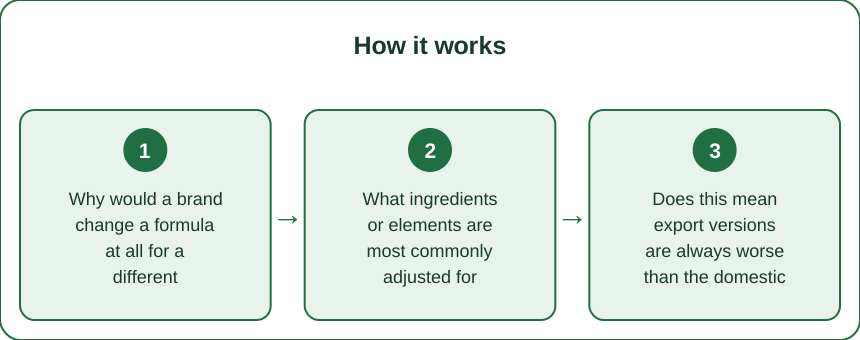
Why would a brand change a formula at all for a different country?
Cosmetic regulations vary significantly by country — certain preservatives, active ingredient concentrations, or fragrance compounds allowed in Korea may be restricted or require different labeling elsewhere, so brands selling internationally often adjust formulas to legally comply with each specific market’s rules.
What ingredients or elements are most commonly adjusted for export?
- Fragrance and certain allergen-labeled compounds, which have different disclosure and concentration rules across regions
- Certain active ingredient concentrations (some exfoliating acids or specific actives), where allowed percentages differ by regulatory region
- Preservative systems, since approved preservative lists differ meaningfully between Korea, the EU, and the US
Does this mean export versions are always worse than the domestic Korean version?
Not necessarily — differences are usually driven by regulatory compliance rather than a deliberate downgrade in quality, though a specific ingredient a person specifically wanted (a particular active at a certain concentration) may genuinely differ between versions.
How can someone tell if a product they’re using is the export or domestic version?
Checking the full ingredient list against a reliably sourced domestic Korean ingredient list for the same named product is the most direct way — a noticeably different fragrance or texture between review sources online can also be a hint the formulas aren’t identical.
Myth vs Fact: K-Beauty Export Reformulation
Myth: A product with the same name and packaging is always chemically identical everywhere it’s sold. Fact: Regulatory requirements can lead to meaningful formula differences between a domestic and export version of the same named product.
Myth: Export reformulation always means a lower-quality product. Fact: It’s primarily about legal compliance with each market’s cosmetic regulations, not necessarily a quality downgrade.
Myth: This kind of reformulation is unique to K-beauty. Fact: Many global beauty brands adjust formulas by region for the same regulatory reasons — it isn’t specific to Korean beauty brands alone.
FAQ: K-Beauty Export Reformulation Questions, Answered
How can I check if a product’s ingredient list matches the domestic Korean version?
Comparing the full ingredient list from a reliable regional retailer or the brand’s own regional site against what’s listed for your purchased version is the most direct way to check.
Does this affect all K-beauty products, or mainly certain categories?
Active-ingredient products (with exfoliants, certain treatment actives) are more likely to show meaningful differences than very simple, low-active formulas like a basic cleanser.
Is there anything wrong with using the export version instead of importing the domestic one?
No — the export version is formulated to be safe and compliant for its intended market; it’s simply worth knowing it may not be a truly identical formula if that specifically matters to you.
TL;DR:
- Cosmetic regulations differ by country, driving real export-version formula changes
- Fragrance, certain actives, and preservative systems are commonly adjusted
- Differences are usually regulatory, not a deliberate quality downgrade
- Comparing full ingredient lists is the most reliable way to check for differences
This is general information, not medical advice — a dermatologist can advise on specific active ingredient concerns.
Keep Reading
This article is for general informational and styling purposes only. Fit, sizing, and product availability may vary.