Do You Need to Change Your K-Beauty Routine When Humidity Drops?
Quick Answer: Yes, but far less than the internet suggests. The hydration layers stay the same - what changes is the occlusive step on top. Humectants like hyaluronic acid and glycerin pull water from the air in humid conditions and can pull it from your skin when the air is dry, so in low humidity they need to be sealed with a cream or facial oil rather than left to dry. Swap one product, not the whole routine: add a richer final step and keep everything underneath it identical.
The drop in humidity from late August through October is what makes a routine that worked in July suddenly feel tight by 11am.
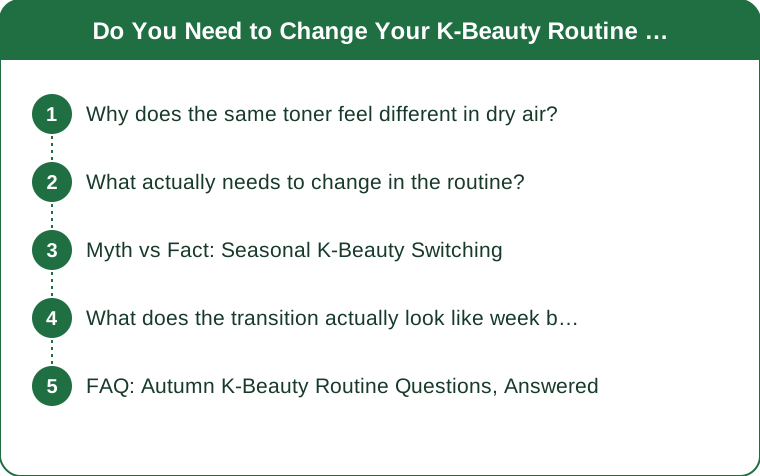
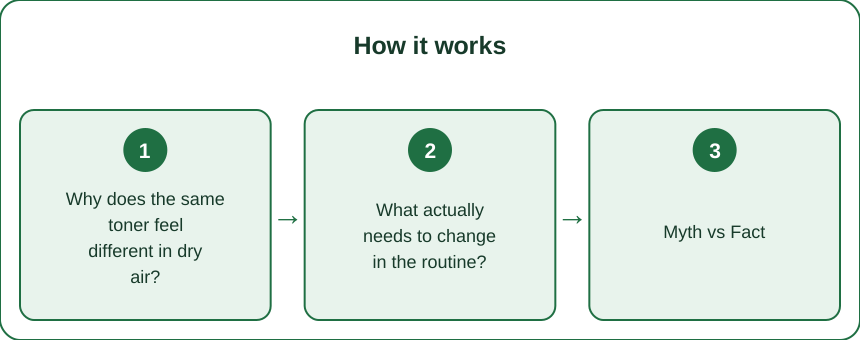
Why does the same toner feel different in dry air?
Because humectants work in both directions, and the direction depends on the air.
Humectants attract water to wherever they are. In humid conditions - the 70%+ humidity of a Korean or Japanese summer, or a muggy August - they pull moisture from the surrounding air into your skin. This is why hydrating layers feel so good in summer and why the routine was designed that way.
In dry air, the nearest available water is inside you. With ambient humidity below roughly 40%, humectants can draw water from the deeper layers of your skin toward the surface, where it evaporates. The net effect is drier skin than if you had applied nothing - which is the exact opposite of the intention.
This is why the same seven-step routine can feel hydrating in July and dehydrating in October. Nothing about the products changed. The air did.
The fix is not to abandon humectants. It is to always follow them with something that traps the water - an emollient cream, a balm, or a facial oil. Sealed humectants work in any humidity. Unsealed humectants only work in humid air.
Indoor heating is the accelerant. Once heating starts, indoor humidity in many homes falls to 20 to 30%, which is drier than most people realise and considerably drier than outdoors.
What actually needs to change in the routine?
One step, plus two small adjustments. That is genuinely all.
Change the last step. The gel moisturiser that was perfect in August becomes the layer that lets everything underneath evaporate. Swap it for a cream with occlusive ingredients - squalane, shea, ceramides, or a small amount of petrolatum in the formulation - or add 2 to 3 drops of facial oil over your usual moisturiser as the simplest possible version.
Apply hydrating layers to damp skin. This is the single highest-value technique in Korean skincare and it matters far more in dry air. Toner or essence on skin that is still slightly wet from cleansing gives the humectants water to hold that is not being taken from your skin.
Reduce the number of watery layers, not the total hydration. Seven thin layers of toner in dry air means seven opportunities for evaporation between applications. Two or three layers applied quickly onto damp skin, then sealed, works better than the full summer stack applied slowly.
Leave the actives alone for now. Vitamin C in the morning, retinoids or exfoliating acids at night - keep the routine you have. Change one variable at a time, because if you swap five products and your skin reacts, you will have no idea which one did it.
And back off exfoliation slightly. A compromised barrier in dry air tolerates less. If you were exfoliating three times a week, drop to two through the transition and see how skin responds.
Myth vs Fact: Seasonal K-Beauty Switching
Myth: You need an entirely different autumn routine. Fact: The cleanse-tone-essence-serum-moisturise structure is sound in any season. Only the final occlusive step reliably needs changing, and often only its richness.
Myth: Hyaluronic acid is drying and should be avoided in winter. Fact: Hyaluronic acid is fine in any season provided it is sealed. The problem is unsealed humectants in dry air, not the ingredient.
Myth: Oily skin does not need a heavier moisturiser in autumn. Fact: Oily skin still loses water through a dry-air barrier. Oil and hydration are different things - a lightweight but genuinely occlusive layer, like squalane, addresses it without heaviness.
Myth: A humidifier is a gimmick. Fact: It is arguably the most effective single intervention available for dry indoor air. Raising bedroom humidity to 40 to 50% overnight does more for skin than most product swaps, and it works for the eight hours you are not applying anything.
Myth: If your skin feels tight, you need more product. Fact: Tightness usually means water is escaping, not that too little was applied. Adding a seal beats adding another watery layer, and it costs less.
What does the transition actually look like week by week?
Two to three weeks, one change at a time.
Week 1 - seal what you already have. Keep everything, add 2 to 3 drops of facial oil or a richer cream as the final night step only. Daytime unchanged. See how skin responds after five days.
Week 2 - adjust the morning. If mornings feel tight by mid-day, move the richer cream to daytime too, or swap the gel moisturiser for a light cream. Watch for congestion if your skin is acne-prone; squalane and ceramide-based creams are typically better tolerated than heavy butters.
Week 3 - fine-tune the layers. Reduce the number of watery layers if you were using several, apply them faster and onto damper skin, and dial exfoliation back if there is any sensitivity.
What to add if the transition is rough: a sleeping mask two or three nights a week as an occlusive overnight layer, and a humidifier in the bedroom. Those two together handle most autumn dryness without touching the rest of the routine.
Signs you have overcorrected: congestion, small bumps, or a heavy feeling that never absorbs. Pull back to a lighter cream and add oil only at night.
Signs you have undercorrected: tightness within an hour of applying, flaking around the nose, makeup clinging to dry patches, or actives that suddenly sting when they never did. The stinging in particular is a barrier signal, not a bad batch, and it means pausing actives for a few days rather than pushing through.
FAQ: Autumn K-Beauty Routine Questions, Answered
Do I need to stop using hydrating toner in dry weather?
No - apply it to damp skin and seal it with a moisturiser or oil. Unsealed humectants in dry air are the problem, not the toner itself.
Should oily skin switch to a heavier moisturiser?
Usually to a slightly more occlusive one rather than a heavier-feeling one. Squalane, ceramides, and lightweight silicones seal effectively without the weight of a rich butter-based cream.
Is a facial oil better than a cream for sealing?
Oils seal well but do not hydrate - they contain no water. The order matters: hydrate first, oil last. A cream does both jobs, which is why most people find a cream simpler.
How do I know if my barrier is damaged rather than just dry?
Stinging from products that were previously fine, persistent redness, and a rough texture point to barrier damage. In that case simplify to cleanser, moisturiser, and sunscreen for one to two weeks and pause all actives.
Should I still wear sunscreen in autumn?
Yes, daily. UVA levels remain meaningful year-round and are the wavelengths most associated with photoaging. This is the step that should never change seasonally.
This is general information, not medical advice. Persistent irritation or skin conditions are worth reviewing with a dermatologist.
TL;DR:
- Humectants pull water from wherever is nearest - in humid air that is the atmosphere, in dry air it can be your own skin.
- Change one step: the occlusive layer on top. A richer cream, or 2 to 3 drops of facial oil over your usual moisturiser.
- Apply hydrating layers to damp skin, use fewer watery layers rather than more, and ease off exfoliation during the transition.
- A bedroom humidifier at 40 to 50% may do more than any product swap once heating starts.
The underlying principle is worth remembering beyond this season: the Korean approach is hydrate-then-seal, and the seal is the part that has to change with the weather. Everything under it can stay exactly as it is.
Keep Reading
This article is for general informational and styling purposes only. Fit, sizing, and product availability may vary.